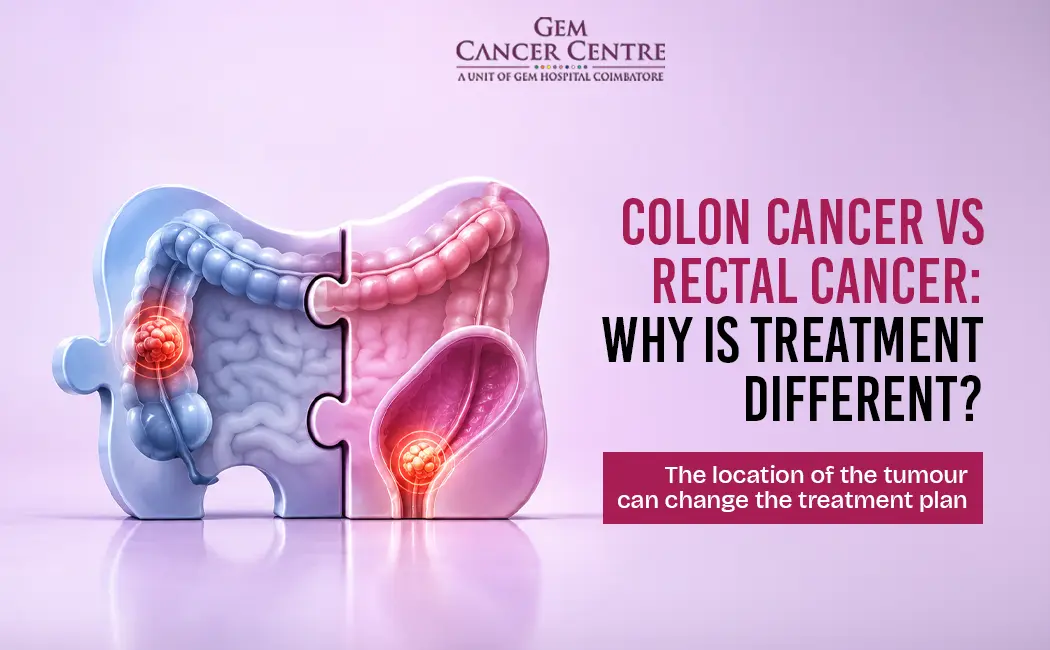
Colon cancer and rectal cancer are often grouped together as colorectal cancer, but their treatment is not always the same.
Both cancers develop in the large intestine, yet the location of the tumour can significantly influence how doctors plan treatment. The rectum is located deep within the pelvis and sits close to important organs, nerves and muscles involved in bowel and bladder function. The colon has more flexibility within the abdomen, which can make the surgical approach different.
For patients looking for Colorectal Cancer Treatment in Coimbatore, understanding this distinction can make it easier to understand why two patients with apparently similar cancers may receive very different treatment plans.
Treatment can involve surgery, chemotherapy, radiation therapy, targeted treatment, immunotherapy or a combination of these approaches. The exact plan depends on the cancer stage, tumour location, pathology, molecular characteristics and overall health.
Is Rectal Cancer Treated Differently from Colon Cancer?
Yes. Rectal cancer often requires a different treatment sequence because of its location in the pelvis.
For many colon cancers, surgery is an important part of treatment, with chemotherapy added before or after surgery depending on the stage and other risk factors.
Rectal cancer may require a more carefully coordinated approach because the tumour is close to the anus, pelvic muscles, nerves and other structures.
Depending on the stage, rectal cancer treatment may involve treatment before surgery, such as chemotherapy, radiation or a combination of systemic and radiation treatment.
This approach can help reduce the tumour and treat microscopic disease before surgery.
The distinction is therefore not simply about the name of the cancer. The location of the tumour directly influences treatment planning.
Why Does the Location of the Tumour Matter?
The anatomy surrounding a tumour affects the type and sequence of treatment.
The colon extends through the abdomen, while the rectum is located within the confined space of the pelvis.
Rectal tumours can be close to:
- The anal sphincter
- Pelvic muscles
- Bladder
- Reproductive organs
- Pelvic nerves
- Nearby lymph nodes
Because of this, surgeons need to consider both cancer removal and preservation of important pelvic functions.
In Colorectal Cancer Treatment in Coimbatore, doctors may therefore use detailed imaging to determine the tumour's exact location and relationship with surrounding structures before deciding on treatment.
Is Surgery the Main Treatment for Colon Cancer?
Surgery is a major treatment for many localised colon cancers.
During colon cancer surgery, the surgeon removes the section of colon containing the tumour along with nearby lymph nodes and surrounding tissue as appropriate.
The remaining sections of bowel may then be joined together.
The type of operation depends on where the tumour is located.
For example, surgery for a tumour in the right side of the colon differs from surgery for a tumour on the left side.
The aim is to remove the cancer adequately while preserving as much healthy bowel function as safely possible.
Depending on the patient's condition, surgery may be performed using:
- Open surgery
- Laparoscopic surgery
- Robotic-assisted surgery
Does Rectal Cancer Usually Need Radiation Therapy?
Radiation therapy is more commonly incorporated into the treatment of selected rectal cancers than colon cancers.
One of the major differences between colon and rectal cancer is the role of pelvic radiation.
Radiation may be recommended for certain rectal cancers, particularly when the tumour has features suggesting a higher risk of local recurrence.
It may be combined with chemotherapy or other systemic treatments before surgery.
Radiation is not automatically required for every rectal cancer patient.
The decision depends on factors such as:
- Tumour stage
- Tumour location
- Lymph-node involvement
- Relationship with surrounding tissues
- Risk of local recurrence
This is one of the key reasons rectal cancer treatment can follow a different pathway from colon cancer treatment.
Why Is Treatment Sometimes Given Before Rectal Cancer Surgery?
Preoperative treatment can reduce the tumour and address cancer cells before surgery.
For selected rectal cancers, treatment may be given before surgery rather than waiting until after the operation.
This approach can involve chemotherapy, radiation therapy or a combination of treatments.
Potential goals include:
- Shrinking the tumour
- Reducing the risk of local recurrence
- Treating microscopic cancer cells early
- Improving the possibility of complete tumour removal
- Increasing the chance of preserving important pelvic structures in selected cases
The exact treatment sequence depends on the stage and characteristics of the cancer.
Can Rectal Cancer Surgery Preserve the Anal Sphincter?
In selected patients, sphincter-preserving surgery may be possible.
The possibility depends heavily on where the tumour is located and how close it is to the anal sphincter.
When appropriate, the surgeon may remove the rectal tumour while preserving the anus and sphincter.
However, this is not possible for every patient.
If the tumour involves structures that cannot be safely preserved, more extensive surgery may be necessary.
The priority is always to remove the cancer safely while achieving the best possible long-term outcome.
Is a Stoma More Common With Rectal Cancer Surgery?
A temporary or permanent stoma may be needed in selected rectal cancer surgeries.
A stoma is an opening created on the abdomen through which stool passes into a specially designed pouch.
A temporary stoma may be created to protect a new bowel connection while it heals.
A permanent stoma may be necessary in some very low rectal cancers when the anus and sphincter cannot be preserved safely.
Having a stoma does not automatically mean that the cancer is advanced.
The need for one depends largely on the tumour location, type of operation and safety of restoring bowel continuity.
Patients undergoing Colorectal Cancer Treatment in Coimbatore should discuss the possibility of a stoma with their surgeon before surgery.
How Is Chemotherapy Used in Colon and Rectal Cancer?
Chemotherapy may be used before or after surgery depending on the cancer and its stage.
For colon cancer, chemotherapy is commonly considered based on the stage and pathological features following surgery.
In some situations, it may also be given before surgery.
For rectal cancer, chemotherapy may be incorporated into treatment before surgery, after surgery or as part of a broader treatment strategy.
The purpose can include:
- Shrinking the tumour
- Treating microscopic disease
- Reducing recurrence risk
- Controlling cancer that has spread
- Improving long-term disease control
The exact medicines and duration are determined by the oncology team.
Are Targeted Therapy and Immunotherapy Used for Both Cancers?
Targeted therapy and immunotherapy may be appropriate for selected colorectal cancers.
Not every colorectal cancer responds to the same medicines.
Doctors may perform molecular or biomarker testing to understand specific characteristics of the tumour.
Depending on the results, treatments may include:
- Targeted therapies
- Immunotherapy
- Chemotherapy
- Combination treatment
Immunotherapy can be particularly relevant in selected colorectal cancers with specific molecular characteristics.
This is why pathology and molecular testing can be an important part of modern Colorectal Cancer Treatment in Coimbatore.
How Does Staging Differ Between Colon and Rectal Cancer?
Both cancers are staged based on how far the disease has spread, but local assessment can be particularly detailed for rectal cancer.
Doctors need to determine:
- How deeply the tumour has grown
- Whether lymph nodes are involved
- Whether nearby structures are affected
- Whether cancer has spread to distant organs
For colon cancer, CT imaging and other investigations may be used to assess the abdomen and chest.
For rectal cancer, detailed pelvic imaging can provide important information about the tumour's relationship with surrounding tissues.
This information helps the multidisciplinary team determine whether treatment should begin with surgery or other therapies.
Why Is MRI Important in Rectal Cancer?
Pelvic MRI can provide detailed information about the location and extent of a rectal tumour.
MRI can help doctors assess important features such as:
- Tumour location
- Depth of tumour involvement
- Nearby lymph nodes
- Relationship with surrounding tissues
- Distance from the anal sphincter
- Certain features associated with local recurrence risk
This information can be particularly useful when planning rectal cancer treatment.
The imaging findings are reviewed alongside pathology and clinical examination.
Is Recovery Different After Colon and Rectal Cancer Surgery?
Recovery varies because the operations and their effects on bowel function can be different.
After colon surgery, patients may experience temporary changes in bowel habits while the digestive system adapts.
Rectal surgery can sometimes have a greater effect on bowel function because the rectum plays an important role in storing stool before bowel movements.
Some patients may experience:
- More frequent bowel movements
- Urgency
- Changes in stool consistency
- Difficulty controlling bowel movements
- Temporary changes in bowel habits
Not every patient experiences these problems and recovery can improve over time.
Your surgeon and rehabilitation team can provide guidance on diet, bowel management and recovery.
Can Colon and Rectal Cancer Be Treated With Minimally Invasive Surgery?
Both colon and rectal cancer may be treated using minimally invasive techniques in suitable patients.
Depending on the tumour and patient's condition, surgeons may use:
- Laparoscopic surgery
- Robotic-assisted surgery
- Open surgery
Minimally invasive approaches use smaller surgical openings and may offer benefits such as reduced wound-related problems and potentially faster recovery for appropriate patients.
However, the surgical technique should be selected based on cancer control and patient safety rather than technology alone.
Why Is a Multidisciplinary Team Important?
Colon and rectal cancers benefit from coordinated care involving multiple specialists.
A colorectal cancer team may include:
- Surgical oncologist
- Medical oncologist
- Radiation oncologist
- Radiologist
- Pathologist
- Gastroenterologist
- Specialist nurses
- Nutrition professionals
- Rehabilitation specialists
This is especially important for rectal cancer because treatment may involve several stages before and after surgery.
A coordinated approach allows specialists to discuss the pathology, imaging and treatment options together.
For patients seeking Colorectal Cancer Treatment in Coimbatore, asking whether their care involves multidisciplinary treatment planning can be useful.
Frequently Asked Questions
1. Is rectal cancer harder to treat than colon cancer?
Not necessarily. Treatment depends on the stage, tumour characteristics and overall health. Rectal cancer can require more complex planning because of its location within the pelvis.
2. What is the main difference between colon and rectal cancer treatment?
The main difference is often the treatment sequence and role of radiation. Selected rectal cancers may receive chemotherapy and radiation before surgery, while many localised colon cancers proceed to surgery first.
3. Does rectal cancer always require radiation?
No. Radiation is recommended only for selected patients based on tumour stage, location and risk factors.
4. Is surgery always required for colon cancer?
Surgery is an important treatment for many localised colon cancers, but the treatment plan depends on the individual diagnosis. Advanced disease may require systemic treatment as well.
5. Can rectal cancer surgery avoid a permanent stoma?
A permanent stoma may be avoided in some patients. Whether this is possible depends mainly on tumour location and whether the anal sphincter can be safely preserved.
6. Why is MRI commonly used for rectal cancer?
Pelvic MRI provides detailed information about the rectal tumour and nearby structures. This can help doctors plan treatment and surgery.
7. Can colorectal cancer be treated with robotic surgery?
Robotic surgery may be appropriate for selected patients. The decision depends on tumour characteristics, surgical requirements and the patient's overall health.
8. Is chemotherapy used for both colon and rectal cancer?
Yes, chemotherapy can be used for both. Its timing and purpose depend on the cancer's stage and individual characteristics.
9. Are immunotherapy and targeted therapy options for colorectal cancer?
They may be appropriate for selected patients. Tumour biomarker and molecular testing can help doctors identify patients who may benefit from these treatments.
10. Where should I seek colorectal cancer treatment in Coimbatore?
Look for a cancer centre with coordinated colorectal, medical oncology and radiation oncology expertise. Ask how staging, surgery, systemic treatment and follow-up will be integrated into your care.
Conclusion
Although colon cancer and rectal cancer are both classified as colorectal cancers, their treatment can be significantly different.
The main reason is anatomy. Colon tumours are located within the abdomen, while rectal tumours develop within the pelvis, close to structures that influence bowel, bladder and sexual function.
For colon cancer, surgery is often a central part of treatment for localised disease, with chemotherapy added when appropriate. For selected rectal cancers, treatment may begin with chemotherapy, radiation or a combination of therapies before surgery.
The exact approach depends on the cancer stage, tumour location, pathology, molecular characteristics and overall health.
If you are considering Colorectal Cancer Treatment in Coimbatore, make sure you understand whether your cancer is located in the colon or rectum and why your specialist has recommended a particular treatment sequence.
A multidisciplinary team can bring together surgical, medical oncology, radiation, pathology and imaging expertise to develop a treatment plan around your individual diagnosis.
The most appropriate colorectal cancer treatment is not determined by the cancer's name alone. It is determined by where the cancer is, how far it has spread and what treatment approach is safest and most effective for that individual patient.
If you or someone in your family has been diagnosed with colon or rectal cancer, discuss the diagnosis and treatment sequence with a colorectal cancer specialist.
For those exploring Colorectal Cancer Treatment in Coimbatore, take your biopsy, pathology and imaging reports to your consultation and ask about the role of surgery, chemotherapy, radiation, molecular testing and follow-up care.
Understanding the difference between colon and rectal cancer treatment can help you understand why your medical team recommends a particular treatment pathway.