Being advised to undergo a PET CT scan can naturally lead to questions: Will it hurt? Do I need to fast? How long will the scan take? What happens after the injection?
If you are looking for a PET CT Scan in Coimbatore, knowing what to expect before arriving at the imaging centre can make the experience less stressful.
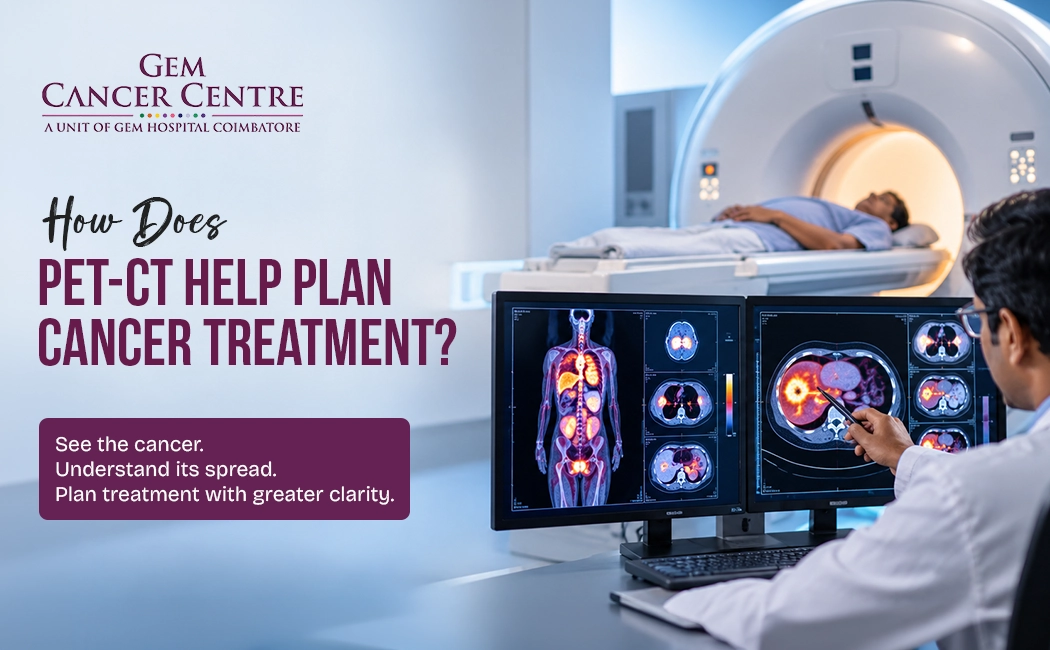
A PET CT scan combines two imaging techniques - Positron Emission Tomography (PET) and Computed Tomography (CT). PET provides information about metabolic activity in the body, while CT provides detailed anatomical images.
In cancer care, PET CT may be used in selected situations to help assess disease, determine its extent, investigate suspected recurrence and evaluate treatment response.
The examination itself is generally straightforward, but preparation and the waiting period after the tracer injection are important parts of the process.
What Is a PET CT Scan?
PET CT combines metabolic and anatomical imaging.
A PET scan uses a small amount of a radioactive tracer to identify areas of increased metabolic activity.
The CT component produces detailed images of the body's internal structures.
When combined, PET and CT can help doctors understand both:
- Where an abnormal area is located
- How metabolically active it appears
This combined information can be particularly useful when evaluating certain cancers.
Why Is a PET CT Scan Done?
PET CT helps doctors assess cancer activity and disease extent.
Depending on the type of cancer and the clinical situation, a PET CT may be recommended to:
- Help stage certain cancers
- Look for cancer spread
- Investigate suspected recurrence
- Assess treatment response
- Clarify findings from other imaging
- Support treatment planning
PET CT is not required for every cancer or every patient.
Your doctor decides whether the information provided by the scan is likely to be useful for your particular situation.
How Should You Prepare for a PET CT Scan?
Follow fasting and medication instructions carefully.
Preparation can vary according to the type of PET CT examination and tracer being used.
For many FDG PET CT scans, patients are instructed not to eat for a specified period before the examination.
You may generally be asked to:
- Avoid food for the instructed period
- Drink plain water as advised
- Avoid strenuous exercise before the scan
- Wear comfortable clothing
- Follow medication instructions
- Inform the team if you have diabetes
- Tell the team if pregnancy is possible
Patients with diabetes may receive specific preparation instructions because blood glucose levels can affect FDG PET imaging.
Do not change prescribed medication unless your healthcare team tells you to do so.
What Happens When You Arrive for the Scan?
The imaging team first confirms your medical details.
When you arrive, the healthcare team may confirm:
- Your identity
- The reason for the scan
- Medical history
- Current medications
- Previous imaging
- Blood glucose level when relevant
- Pregnancy status when applicable
You may also be asked whether you have any allergies or medical conditions that the team should know about.
This preliminary assessment helps the imaging team perform the examination safely and appropriately.
Is a Tracer Used During PET CT?
Yes, a small amount of radioactive tracer is usually injected.
For many cancer-related PET CT examinations, a tracer called FDG is used.
FDG behaves similarly to glucose and is taken up by cells that use glucose.
The tracer is administered through an intravenous injection.
The amount used is carefully controlled for medical imaging purposes.
Does the PET CT Injection Hurt?
The injection usually feels like a routine IV injection.
You may experience a brief pinch or mild discomfort when the tracer is administered.
After the injection, you generally rest while the tracer distributes throughout the body.
The tracer itself is not typically felt moving through the body.
Why Do You Have to Wait After the Injection?
The waiting period allows the tracer to distribute properly.
The PET images are not taken immediately after the tracer is administered.
You may be asked to rest quietly for a period of time.
During this period, the tracer travels through the body and accumulates in tissues according to its biological distribution.
The exact waiting period varies depending on the tracer and examination protocol.
You may be asked to:
- Remain relaxed
- Avoid unnecessary movement
- Avoid talking excessively
- Follow the imaging team's instructions
The aim is to obtain good-quality images.
Why Is It Important to Stay Still Before the Scan?
Rest helps reduce unwanted tracer uptake and improves imaging quality.
Physical activity can increase glucose use in muscles.
For an FDG PET examination, significant activity before imaging can affect how the tracer is distributed.
This is why patients are generally asked to rest quietly during the uptake period.
Following these instructions helps the medical team obtain images that are easier to interpret.
What Happens During the PET CT Scan?
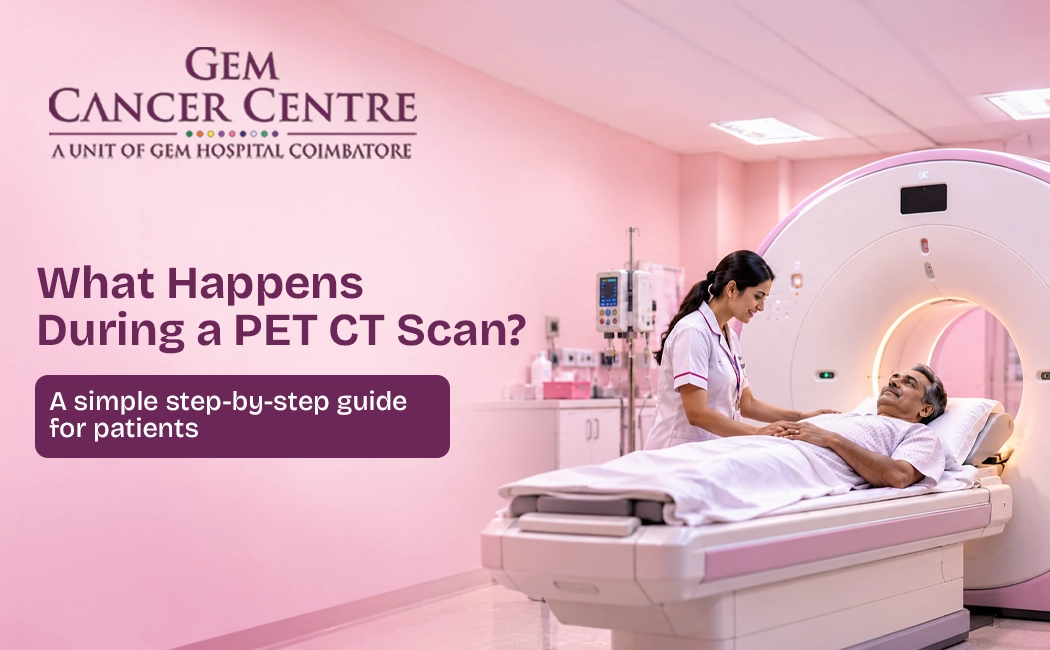
You lie still while the scanner captures PET and CT images.
Once the tracer has had sufficient time to distribute, you are taken to the scanning room.
You will usually lie on a narrow examination table.
The table slowly moves through the PET CT scanner.
The imaging process itself is generally painless.
You need to remain as still as possible while the images are acquired.
Does a PET CT Scan Hurt?
The scan itself is generally painless.
Unlike some surgical procedures or invasive tests, PET CT does not usually involve pain during image acquisition.
The main discomforts may be:
- The tracer injection
- Lying still for a period
- Feeling anxious in the scanner environment
If you are uncomfortable or have difficulty remaining still, tell the imaging team.
How Long Does a PET CT Scan Take?
The entire appointment can take several hours.
It is important to distinguish between the actual scanning time and the total appointment time.
The appointment can include:
- Registration and preparation
- Tracer injection
- Resting or uptake period
- PET CT imaging
- Post-scan instructions
The actual image acquisition may be relatively short compared with the overall visit.
Your imaging centre can provide a more specific estimate based on the examination being performed.
What Does the CT Part of the Scan Do?
CT provides detailed anatomical information.
The CT component shows structures such as:
- Organs
- Bones
- Blood vessels
- Lymph nodes
- Soft tissues
This anatomical information helps identify exactly where an area of increased PET activity is located.
What Does the PET Part of the Scan Show?
PET highlights areas of increased tracer uptake.
Some cancers can show increased metabolic activity and therefore increased FDG uptake.
However, increased uptake does not automatically mean cancer.
Infection, inflammation and some benign conditions can also show increased uptake.
This is why PET CT images must be interpreted by appropriately trained specialists and considered alongside other clinical information.
What Happens After the PET CT Scan?
You can usually return to normal activities unless advised otherwise.
After the scan, the imaging team may provide specific instructions.
The radioactive tracer naturally decreases in the body over time and is eliminated, primarily through urine.
Patients are commonly advised to drink fluids if permitted and to follow any centre-specific instructions.
If you have been given special precautions because of the tracer or your medical circumstances, follow those instructions carefully.
Can You Eat After a PET CT Scan?
Most patients can resume eating after the scan.
Unless your healthcare team has provided different instructions, normal food can generally be resumed after the examination.
If another medical procedure is scheduled, follow the preparation instructions for that procedure.
Is PET CT Safe?
PET CT uses controlled radiation for medical imaging.
PET CT involves radiation from both the radioactive tracer and the CT component.
The examination is performed when the expected medical benefit justifies the exposure.
The tracer used for PET imaging also decreases over time and is eliminated from the body.
Tell your healthcare team if you are pregnant, may be pregnant or are breastfeeding so appropriate precautions can be considered.
Can a PET CT Diagnose Cancer by Itself?
No, PET CT findings need clinical interpretation.
A PET CT can provide valuable information, but it does not independently confirm every cancer diagnosis.
A doctor may consider:
- PET CT findings
- Biopsy results
- Histopathology
- Blood tests
- CT or MRI results
- Symptoms
- Medical history
If a suspicious area is found, additional imaging or biopsy may be recommended.
Does an Abnormal PET CT Always Mean Cancer?
No, increased tracer uptake can have other causes.
Increased uptake may occur with:
- Infection
- Inflammation
- Certain benign conditions
- Recent procedures
- Some normal tissues
Likewise, some cancers may not show strong uptake.
Therefore, patients should avoid interpreting isolated PET CT findings without discussing the report with their doctor.
How Are PET CT Results Reported?
A specialist reviews the images and prepares a report.
The PET CT images are evaluated by appropriately trained imaging specialists.
The report may describe:
- Areas of increased or decreased tracer uptake
- Anatomical findings on CT
- Lymph node findings
- Possible distant lesions
- Comparison with previous scans when available
Your treating doctor then interprets the findings in the context of your overall medical condition.
What Should You Bring for a PET CT Appointment?
Bring previous reports and follow your preparation instructions.
It can be useful to carry:
- Previous scan reports
- CT or MRI images
- Biopsy reports
- Blood test results
- Current medication details
- Referral or prescription
- Previous PET CT reports, if applicable
Previous imaging can help specialists compare changes over time.
What If You Have Diabetes?
Tell the PET CT team before the examination.
Blood glucose levels can influence FDG PET imaging.
People with diabetes may therefore receive specific instructions regarding:
- Food
- Diabetes medication
- Insulin
- Appointment timing
- Blood glucose measurement
Do not change diabetes medication on your own. Follow the instructions provided by the medical and imaging team.
Frequently Asked Questions
1. What happens first during a PET CT scan?
The team checks your details and preparation. You may then undergo tracer administration and a resting period before imaging.
2. Is a PET CT scan painful?
The scan itself is generally painless. The tracer injection may cause brief discomfort similar to a routine injection.
3. How long does a PET CT appointment take?
The appointment can take several hours. Most of the time includes preparation and the tracer uptake period rather than actual scanning.
4. Do I need to fast before a PET CT?
Many FDG PET CT scans require fasting. Follow the exact fasting instructions provided by your imaging centre.
5. Can I drink water before PET CT?
Plain water is often allowed. Follow the specific instructions given by your PET CT team.
6. Why do I have to rest after the tracer injection?
Rest allows the tracer to distribute properly. Physical activity can affect tracer uptake, particularly in muscles.
7. Can I drive home after a PET CT scan?
Many patients can resume normal activities after the scan. Follow any specific instructions provided by your healthcare team.
8. Does PET CT detect all cancers?
No, PET CT cannot detect every cancer. Its usefulness depends on the cancer type and the tracer used.
9. When will I receive my PET CT results?
Report timing varies between imaging centres. Ask the centre when your report will be available and who will explain the findings.
10. What should I do if my PET CT shows an abnormality?
Discuss the finding with your treating doctor. An abnormal area may require additional imaging, follow-up or biopsy before a diagnosis is made.
Conclusion
A PET CT scan may sound complicated, but the process is usually straightforward once you know what to expect.
If you are scheduled for a PET CT Scan in Coimbatore, the examination generally involves preparation, administration of a tracer, a quiet resting period and then PET and CT imaging.
The scan itself is usually painless, although the appointment can take several hours because the tracer needs time to distribute through the body.
PET CT can provide important information about metabolic activity and anatomy and may help doctors assess cancer, determine its extent, plan treatment or monitor response in selected situations.
Remember that a PET CT report should always be interpreted in the context of your symptoms, medical history, biopsy results and other investigations.
If your doctor has recommended a PET CT scan, ask the imaging team about fasting, medications, diabetes-related preparation, the expected appointment duration and when you can receive your report.
Knowing what to expect can make your PET CT experience less stressful and help you feel more prepared for the next step in your care.