A stomach cancer diagnosis does not always mean that major surgery is immediately required.
When stomach cancer or a very early gastric neoplastic lesion is detected at a superficial stage, selected patients may be candidates for an advanced endoscopic procedure called Endoscopic Submucosal Dissection (ESD).
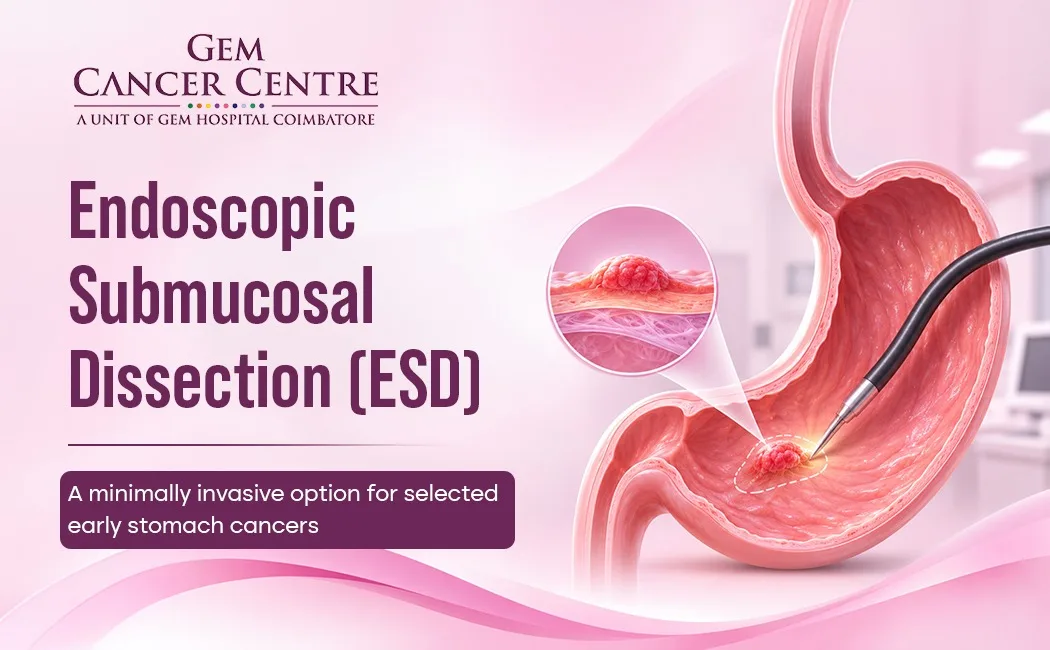
Unlike conventional stomach cancer surgery, ESD is performed through an endoscope passed through the mouth. The doctor removes the abnormal area from the stomach lining without making an external abdominal incision.
But ESD is not suitable for every stomach cancer patient.
Whether it can be considered depends on factors such as the depth of the tumour, its size, location, appearance, ulceration, differentiation and the estimated risk that cancer has spread to lymph nodes.
For patients researching Stomach Cancer Treatment in Coimbatore, understanding where ESD fits into modern early gastric cancer care can help explain why early detection and expert endoscopic assessment are so important.
What Is Endoscopic Submucosal Dissection?
Endoscopic Submucosal Dissection is a minimally invasive procedure used to remove selected superficial lesions from the gastrointestinal tract in one piece.
During ESD, a specially designed endoscope is introduced through the mouth and guided into the stomach.
The specialist identifies the abnormal area and carefully separates it from the deeper layers of the stomach wall.
The objective is to remove the lesion completely while preserving as much healthy stomach tissue as possible.
Because the procedure is performed through the digestive tract, there is no external surgical incision through the abdominal wall.
ESD is particularly valuable when a lesion is superficial and the likelihood of lymph-node spread is considered very low.
Current international endoscopy guidance recommends ESD as the treatment of choice for most appropriate superficial gastric lesions, with patient selection based on detailed endoscopic and pathological criteria.
How Is ESD Different From Stomach Cancer Surgery?
ESD removes a selected superficial lesion through an endoscope, while conventional surgery removes part or all of the stomach through an operation.
This is an important distinction.
Endoscopic Submucosal Dissection
ESD:
Uses an endoscope
Does not require an abdominal incision
Removes the targeted lesion from within the stomach
Preserves the remaining stomach
Is intended for carefully selected superficial lesions
Surgical Treatment
Stomach cancer surgery may involve:
- Partial gastrectomy
- Total gastrectomy
- Lymph-node removal
- Reconstruction of the digestive tract
Surgery may be necessary when the cancer extends deeper into the stomach wall or when there is a significant risk of lymph-node involvement.
Therefore, ESD is not simply a “less invasive version” of surgery for every stomach cancer.
It is a specific treatment for appropriately selected early lesions.
When Is ESD Used in Stomach Cancer Treatment in Coimbatore?
ESD may be considered when a stomach lesion is superficial and meets appropriate clinical, endoscopic and pathological criteria.
This is where accurate diagnosis becomes extremely important.
Doctors need to determine whether the lesion is confined to the superficial layers of the stomach and whether its characteristics suggest a sufficiently low risk of lymph-node spread.
Factors considered include:
- Depth of invasion
- Tumour size
- Tumour differentiation
- Ulceration
- Location
- Surface appearance
- Histological characteristics
- Lymphovascular invasion
- Overall clinical assessment
For patients exploring Stomach Cancer Treatment in Coimbatore, this means the decision about ESD cannot be made simply from the word “early” in a report.
A specialist needs to assess the lesion carefully.
Why Does the Depth of the Tumour Matter?
The deeper a gastric tumour grows, the greater the concern about lymph-node involvement and whether endoscopic treatment alone is adequate.
The stomach wall contains several layers.
A superficial lesion confined to the mucosal layer may behave differently from a tumour that has penetrated deeper into the submucosa or beyond.
ESD is primarily intended for lesions where the risk of lymph-node spread is sufficiently low to make local endoscopic removal appropriate.
If deeper invasion is suspected, the treatment plan may change.
The patient may need additional staging and consideration of surgical or systemic treatment.
Does Tumour Size Matter for ESD?
Yes. Tumour size is one of the factors considered when determining whether ESD is appropriate.
However, size should not be viewed independently.
A larger lesion is not automatically unsuitable for ESD, just as a smaller lesion is not automatically suitable.
Doctors consider size together with:
- Histology
- Depth
- Ulceration
- Differentiation
- Surface characteristics
- Risk of lymph-node spread
Current guidelines provide specific criteria for selected gastric lesions, but the final decision needs to be individualised by an experienced endoscopist and oncology team.
How Is Early Stomach Cancer Diagnosed Before ESD?
Upper GI endoscopy with careful examination and biopsy is central to diagnosing suspicious stomach lesions.
An endoscope provides a direct view of the stomach lining.
The specialist may assess:
- Surface irregularity
- Changes in colour
- Ulceration
- Abnormal vessels
- Raised or depressed areas
- Lesion boundaries
A biopsy can then provide tissue for pathological examination.
For patients wanting to understand the diagnostic pathway, GEM Cancer Centre's existing article on how stomach cancer is diagnosed in Coimbatore explains the role of upper GI endoscopy, biopsy and other investigations.
GEM Cancer Centre's stomach cancer service also lists advanced endoscopy and endoscopic ultrasound (EUS) among its diagnostic capabilities.
Is Endoscopic Ultrasound Always Needed Before ESD?
Not necessarily. The need for EUS depends on the lesion and the clinical question being evaluated.
EUS can provide information about the layers of the stomach wall and nearby lymph nodes.
It may be useful in selected situations, particularly when there is uncertainty about the depth of invasion.
However, advanced endoscopic assessment of the lesion itself is also extremely important.
The treating specialist decides which investigations are appropriate based on the lesion's appearance and suspected stage.
How Is Endoscopic Submucosal Dissection Performed?
ESD involves marking the lesion, creating an entry into the submucosal layer and carefully dissecting beneath the lesion until it can be removed.
Although the exact technique varies according to the lesion and operator, the procedure generally involves several stages.
1. Identifying the Lesion
The endoscopist carefully examines the stomach and defines the abnormal area.
2. Marking
The margins of the lesion are identified to help guide complete removal.
3. Creating a Submucosal Entry
Fluid may be injected beneath the lesion to lift it away from deeper tissue layers.
4. Making the Mucosal Incision
A controlled incision is made around the lesion.
5. Submucosal Dissection
The specialist carefully separates the lesion from the deeper stomach wall.
6. En Bloc Removal
When feasible, the lesion is removed as one complete specimen.
7. Pathology Examination
The removed tissue is sent for detailed pathological assessment.
This final step is extremely important because the pathology report helps determine whether the ESD has achieved the desired oncological outcome.
Why Is Removing the Lesion in One Piece Important?
En bloc removal allows the entire lesion to be examined as a single specimen and can provide more accurate pathological assessment.
The pathologist can assess:
- Tumour size
- Depth of invasion
- Differentiation
- Margins
- Lymphovascular invasion
- Other features relevant to treatment planning
This information helps determine whether the ESD can be considered curative or whether additional treatment should be discussed.
In some cases, the pathology findings after ESD may change the treatment plan.
That is why ESD is both a treatment procedure and an important source of detailed pathological information.
What Happens After ESD?
After ESD, the patient is monitored for complications and the removed tissue is examined carefully by pathology.
The immediate recovery depends on:
- Size of the lesion
- Duration of the procedure
- Patient's overall health
- Presence of complications
- Local hospital protocols
The doctor may recommend a period of observation and specific dietary instructions.
The pathology report then becomes an important part of deciding what happens next.
If the lesion has been completely removed and meets the criteria for curative treatment, regular endoscopic surveillance may be recommended.
If high-risk features are identified, additional treatment may be necessary.
Is ESD a Cure for Early Stomach Cancer?
ESD can be curative for appropriately selected early gastric lesions, but not every lesion treated with ESD is considered cured.
The final assessment depends heavily on pathology.
Doctors may look at:
- Whether the lesion was completely removed
- Whether the margins are clear
- Depth of invasion
- Tumour differentiation
- Lymphovascular invasion
- Other high-risk pathological features
If the findings meet accepted curative criteria, no immediate additional treatment may be necessary apart from surveillance.
If the findings indicate a higher risk of residual disease or lymph-node spread, the multidisciplinary team may recommend additional treatment.
When Is Surgery Needed Instead of ESD?
Surgery may be recommended when the lesion is too deep, has high-risk features or cannot be safely and completely removed endoscopically.
Examples of situations that may prompt consideration of surgery include:
- Deep submucosal invasion
- High-risk pathology
- Significant lymphovascular invasion
- Inability to achieve complete removal
Features suggesting meaningful lymph-node risk
Lesion characteristics outside accepted endoscopic-treatment criteria
The decision is not simply based on whether ESD is technically possible.
The primary question is whether ESD provides adequate cancer treatment.
If the cancer has a significant risk of spreading to lymph nodes, removing only the visible lesion may not be sufficient.
Does ESD Remove Lymph Nodes?
No. ESD removes the targeted lesion but does not remove regional lymph nodes.
This is one of the major differences between ESD and oncological stomach surgery.
When a cancer has a meaningful risk of lymph-node spread, surgery may be necessary because it can remove the primary tumour together with regional lymph nodes.
Therefore, ESD is appropriate only when the expected risk of lymph-node metastasis is sufficiently low.
What Are the Benefits of ESD?
For appropriately selected early lesions, ESD can remove the abnormal tissue while preserving the stomach and avoiding major abdominal surgery.
Potential advantages include:
- No external abdominal incision
- Preservation of stomach anatomy
- Removal of selected lesions in one piece
- Detailed pathological examination
Potentially shorter recovery than major stomach surgery
Avoidance of gastrectomy in appropriately selected cases
However, these benefits apply to suitable patients.
ESD should not be promoted as an alternative to surgery when surgery is medically necessary.
What Are the Possible Risks of ESD?
ESD is minimally invasive, but it is still a specialised procedure with potential complications.
Possible risks include:
Bleeding
Bleeding can occur during or after the procedure.
Perforation
A deeper injury to the stomach wall can occasionally result in perforation.
Post-Procedure Pain or Discomfort
Some patients may experience discomfort following the procedure.
Delayed Bleeding
Bleeding can occasionally occur after the procedure rather than immediately.
Incomplete or Non-Curative Resection
If pathology shows high-risk features or incomplete removal, additional treatment may be required.
The risk profile depends on the lesion, procedure and patient's individual health.
How Does ESD Compare With EMR?
ESD and EMR are both endoscopic removal techniques, but ESD allows more controlled dissection of larger or more complex superficial lesions.
EMR stands for Endoscopic Mucosal Resection.
In EMR, the superficial lesion is lifted and removed, often using a snare.
ESD involves dissecting beneath the lesion so that larger or more complex lesions can potentially be removed in one piece.
For selected small, superficial lesions, EMR may be appropriate.
For many superficial gastric lesions where en bloc removal is important, ESD is generally preferred.
The choice depends on the lesion's size, morphology, suspected depth and other clinical features.
Why Is Experience Important When Performing ESD?
ESD is technically demanding and requires specialised endoscopic expertise.
The stomach wall is thin and contains blood vessels and other structures that require careful handling.
An experienced endoscopist needs to:
- Define lesion margins
- Assess depth
- Select an appropriate technique
- Control bleeding
- Avoid perforation
- Achieve complete removal where possible
- Recognise complications promptly
This is why patients should discuss the experience of the treating endoscopy team when considering ESD.
For patients looking for Stomach Cancer Treatment in Coimbatore, the availability of advanced endoscopy should be considered alongside pathology, oncology and surgical expertise.
What Happens If ESD Shows High-Risk Cancer?
Additional treatment may be recommended if the final pathology shows features suggesting that ESD alone may not provide adequate cancer control.
The pathology findings may indicate:
- Deeper invasion than expected
- Positive vertical margins
- Lymphovascular invasion
- Poor differentiation
- Other high-risk features
In such cases, the multidisciplinary team may discuss additional staging, surgery or other treatment.
This does not mean the ESD was unnecessary.
The procedure may have provided valuable diagnostic and pathological information while removing the visible lesion.
What Follow-Up Is Needed After ESD?
Regular endoscopic follow-up is important after ESD.
Follow-up may be recommended to:
- Check the treated area
- Look for local recurrence
- Detect new gastric lesions
- Monitor the stomach lining
- Review symptoms
The exact surveillance schedule depends on the pathology and individual clinical situation.
Patients should attend all recommended follow-up appointments even when the initial ESD has been considered curative.
How Does ESD Fit Into Stomach Cancer Treatment in Coimbatore?
ESD is one part of the broader treatment pathway for selected early gastric lesions.
A patient may move through several stages:
Symptoms or screening concern
↓
Upper GI Endoscopy
↓
Biopsy and lesion assessment
↓
Staging and suitability assessment
↓
ESD or another appropriate treatment
↓
Detailed pathology
↓
Surveillance or additional treatment if required
For patients seeking Stomach Cancer Treatment in Coimbatore, this highlights why early diagnosis and multidisciplinary decision-making are important.
GEM Cancer Centre's dedicated stomach cancer treatment service describes advanced endoscopy, EUS, pathology, imaging, molecular testing and multidisciplinary treatment planning as part of its stomach cancer care.
What Do Patients Say About Care at GEM Cancer Centre?
Patient reviews can offer insight into the experience of communication and support, although they should not be treated as evidence of a particular treatment outcome.
Public Google feedback for GEM Cancer Centre includes comments about clear explanations and supportive care. One patient review noted that “the doctors explained the treatment plan clearly” and answered questions patiently.
Another patient highlighted the team's “kindness, patience, and gentle approach” during a difficult treatment period.
These reviews describe patients' experiences with the centre's care and communication generally; they should not be interpreted as reviews specifically of ESD or stomach cancer treatment.
For someone considering treatment, these experiences can be considered alongside the centre's clinical expertise, diagnostic capabilities and multidisciplinary services.
Frequently Asked Questions
- What is endoscopic submucosal dissection?Endoscopic submucosal dissection, or ESD, is an advanced endoscopic procedure used to remove selected superficial lesions from the stomach in one piece.
- Is ESD used for all stomach cancers?
No. ESD is intended for carefully selected early or superficial gastric lesions. Cancers with deeper invasion or significant lymph-node risk may require surgery or other treatment. - Is ESD a type of stomach cancer surgery?
ESD is an endoscopic treatment rather than conventional abdominal surgery. The procedure is performed through an endoscope passed through the mouth. - Does ESD remove the whole stomach?
No. ESD removes the targeted superficial lesion while preserving the remaining stomach. - Does ESD remove lymph nodes?
No. ESD removes the visible lesion but does not provide regional lymph-node removal, which is one reason careful patient selection is essential. - Is ESD better than gastrectomy?
Neither is universally better. ESD is appropriate for selected superficial lesions with a low risk of lymph-node spread, while gastrectomy may be necessary for deeper or higher-risk cancers. - How long does recovery after ESD take?
Recovery varies depending on the lesion, procedure and individual health. Your treating specialist will provide specific instructions about observation, diet and follow-up. - Can stomach cancer come back after ESD?
Recurrence or new gastric lesions can occur, which is why follow-up endoscopy is important. The risk depends on the original lesion and pathology. - What happens if the pathology after ESD shows high-risk features?|
Additional treatment may be recommended. The multidisciplinary team may consider further staging, surgery or another appropriate treatment depending on the pathology. - Where can I discuss ESD for stomach cancer in Coimbatore?
Patients can discuss ESD with a gastrointestinal oncology and advanced endoscopy team. Suitability depends on detailed assessment of the lesion and pathology rather than the diagnosis alone.
Conclusion
Endoscopic Submucosal Dissection has become an important treatment option for selected patients with early stomach cancer and superficial gastric lesions.
Its major advantage is that it can remove an appropriately selected lesion through an endoscope while preserving the stomach and avoiding the need for major abdominal surgery.
However, ESD is not suitable for every stomach cancer.
The depth of tumour invasion, size, location, ulceration, differentiation, lymphovascular involvement and other pathological features all influence whether endoscopic treatment is appropriate.
For patients considering Stomach Cancer Treatment in Coimbatore, the process should begin with accurate diagnosis and careful assessment of the lesion. Advanced endoscopy, pathology, imaging and multidisciplinary review can help determine whether ESD, surgery or another treatment approach is more appropriate.
Most importantly, a minimally invasive procedure should only be chosen when it provides adequate cancer treatment.
Early diagnosis can create more treatment possibilities. When an early gastric lesion is detected, discussing endoscopic treatment options with an experienced specialist may help determine whether ESD is appropriate for you.
If you have been diagnosed with an early stomach lesion or have an abnormality detected during an upper GI endoscopy, ask your specialist:
Is the lesion superficial?
How deep does it appear to be?
Is ESD appropriate?
What does the biopsy show?
Is there a risk of lymph-node involvement?
Would surgery provide better cancer control?
What follow-up would be required after treatment?
For patients seeking Stomach Cancer Treatment in Coimbatore, early specialist assessment can help identify the most appropriate treatment pathway for the individual diagnosis.
The right treatment depends not only on finding cancer, but on understanding exactly how deep it is, where it is located and what its biological and pathological features show.